Photoelectron Circular Dichroism
Sophia Wismar, University of Denver, Physics Major
Mentored by Dr. Vinod Kumarappan
The focus of our project is studying photoelectron circular dichroism and ion fragmentation in epichlorohydrin molecules. We use a Ti:Sapphire laser beam and the set-up seen in Figure 1 to rotationally align the molecules with two pump pulses and ionize them with a probe pulse. We then use micro-channel plates for photoelectron multiplication and velocity map imaging to create a 2D array of the subsequent photoelectron distribution and ion fragmentation. The photoelectrons excite a phosphor screen, which emits photons that are then detected by a TimePix3 camera. By doing this we can learn more about the forward/backward asymmetry of the photoelectron distribution and the chirality of the epichlorohydrin molecule.
Chiral molecules like epichlorohydrin are molecules that cannot be superimposed over their own mirror image. Understanding the chirality or handedness of a molecule is important for applying it to certain contexts such as pharmaceuticals. As the human body cannot process certain left or right handed molecules it is crucial to understand a molecule's chirality lest improper applications of certain drugs lead to disastrous outcomes [1]. In our case, we use circularly polarized light to ionize the epichlorohydrin molecule with the goal of seeing the forward/backward photoelectron asymmetry reverse when we change the handedness of the light’s polarization [2].
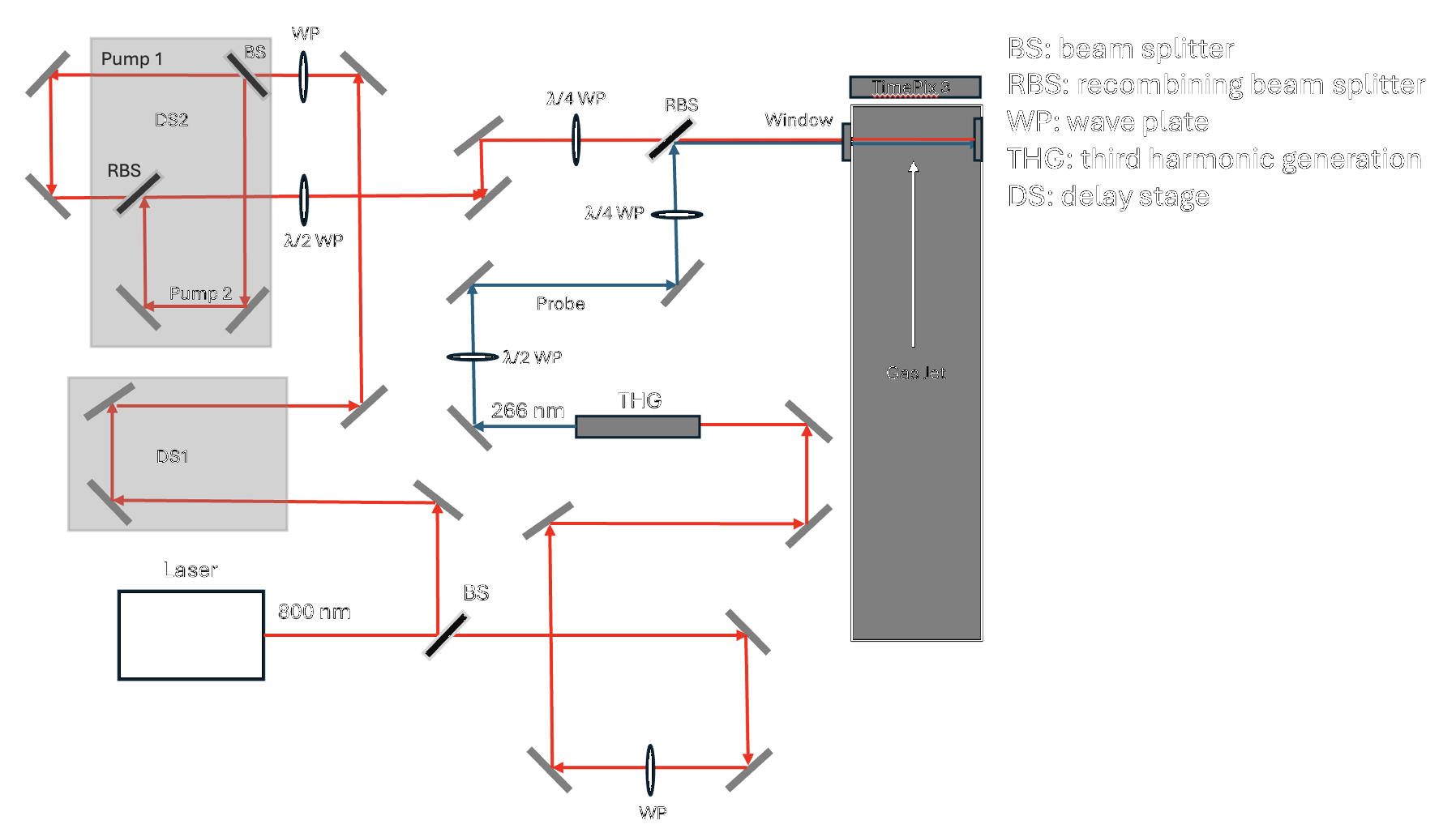
Fig. 1. Experimental set-up
Our experimental set-up, as seen in Figure 1, is a pump-probe set-up that uses a pulsed Ti: Sapphire 800 nm laser. We split the laser into two paths: the first path is split into two pump pulses that are used to align the molecules and the second path undergoes third harmonic generation, generating a 266 nm probe pulse that ionizes the molecules. Two delay stages are used in the first path to vary the time between the pump pulses. To ensure optimal alignment of the molecules we use a pulsed gas jet in a vacuum chamber to induce adiabatic expansion and cool the molecules.
Our TimePix3 camera only collects data from pixels when the signal intensity reaches a certain threshold and each pixel resets after a short turnaround time [3]. Through this camera we can measure time of flight (TOF), time of arrival (TOA), and position information, which allows us to create a 2D histogram of our electron distribution and PECD signal (Figure 2). By collecting TOA information we can also determine the mass-to-charge ratio of each ion, identify them, and create plots of ion yield vs time of flight (Figure 3).
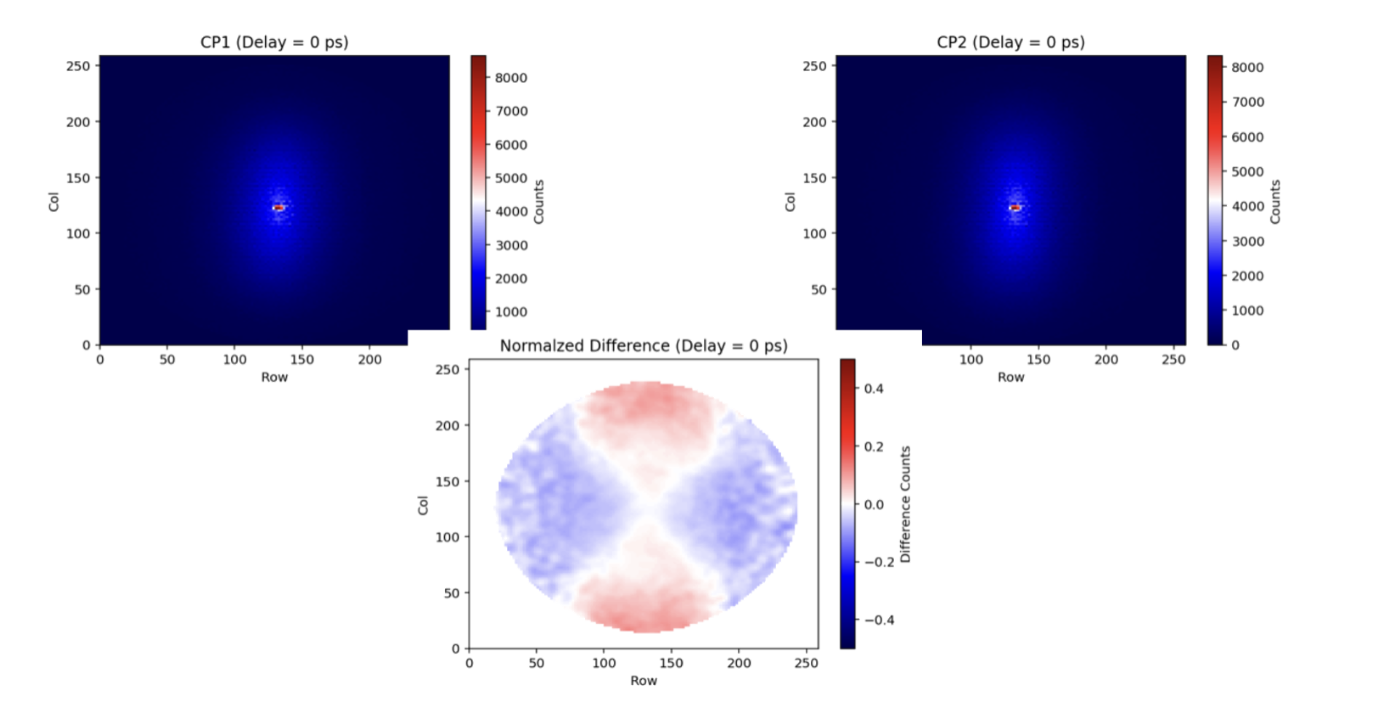
Fig. 2. The forward/backward asymmetry of the electron distribution. Both the pump and probe lasers are circularly polarized. While the polarization of the pump laser does not change, the handedness of the probe lasers switch from left to right (CP1 and CP2). The intensity values of CP1 and CP2 are used to calculate the normalized difference of the electron distribution.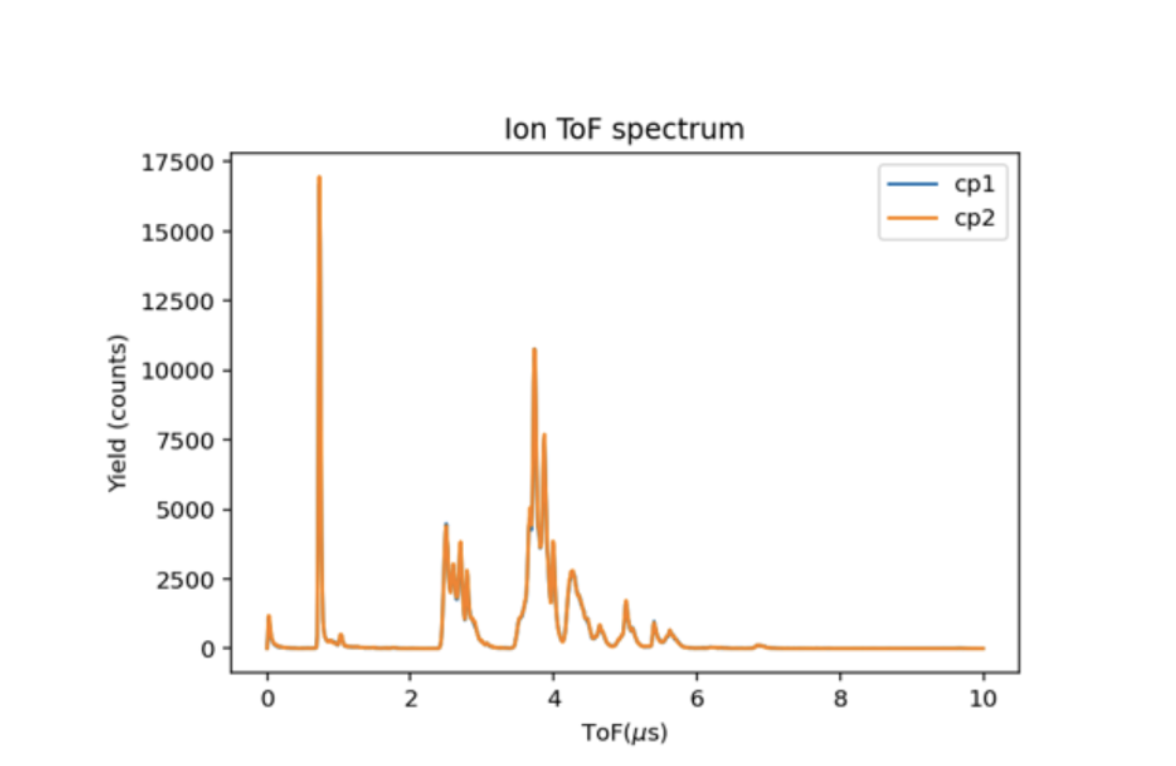
Fig. 3. Ion yield vs time of flight. Each peak corresponds to a specific ion and the different colors represent left and right circularly polarized light.
I spent most of my time this summer in the lab learning how to align the pump-probe set-up, obtaining temporal and spatial overlap between the pump and probe pulses using difference frequency generation (DFG), and loading our sample into the gas chamber. I also spent the last two weeks working on Python code to implement the Welford Algorithm for error analysis. However, the PECD signal strength is currently less than 1% and the experiment requires a significantly larger amount of data than what is currently available. Future work will include improving signal strength and decreasing noise.
References
[1] C. Sparling & D. Townsend, Two decades of imaging photoelectron circular dichroism: from first principles to future perspectives, Phys. Chem. Chem. Phys. (2025) 27 (6): 2888–2907.
[2] I. Powis, Photoelectron spectroscopy and circular dichroism in chiral molecules, J. Phys. Chem. A (2000) 104 (5): 878–882.
[3] L. Chalenrauth-Pham, Studying rotational dynamics of epichlorohydrin using a Timepix3 camera, Kansas State University Department of Physics (2025).
Acknowledgments
Thank you to Dr. Vinod Kumarappan, Kamrunnahar Kali, Wyatt Jones, Kim Coy, Dr. Cosmin Blaga and Dr. Bret Flanders. This material is based upon work supported by the National Science Foundation under Grant No. 2548403 (the REU program) and 2018286 (the TPX3 camera). Participants from K-State were supported by the US Department of Energy under Grant No. DE-FG02-86ER13491. Any opinions, findings, and conclusions or recommendations expressed in this material are those of the author(s) and do not necessarily reflect the views of the National Science Foundation or the Department of Energy.